

Out on the roads of North America, keeping trucks visible isn’t just about safety – it’s required by law. By now, in 2026, rules from the DOT and NHTSA remain strict about how easily vehicles can be seen. Failing to follow them might mean penalties, but also internal issues like legal trouble or damage to reputation. Companies that handle large fleets or ship goods widely must pay close attention, since meeting these standards ties directly to handling danger and meeting ethical expectations. Every semi-trailer must carry first-class reflective gear so crashes don’t spiral out of control —safety, legal shields, penalties follow if standards slip.
The Regulatory Framework: Understanding FMVSS 108
The cornerstone of truck visibility in North America is Federal Motor Vehicle Safety Standard (FMVSS) 108. This regulation dictates the performance and placement of all lamps, reflective devices, and associated equipment.
What is DOT-C2 Certification?
A strip of reflective tape—also called conspicuity tape—needs to be no narrower than two inches to count as lawful under DOT rules. Marked with the code “DOT-C2,” that symbol ought to show up along its length at least once each four-foot stretch. Without it, the tape fails an essential test based on set standards for how much light it bounces back. Inspectors have been known to shut down vehicles when they spot ordinary, nameless versions of this tape applied incorrectly.
Durability and ESG in Fleet Operations
When looking at ESG factors, selecting tough materials lines up with cutting waste and supporting communities. Items made strong tend to last longer, especially where demands are extreme. Since 1999, our plant has focused on making iron and steel parts for trucks. For the U.S. and Canadian scene, building to endure is simply required.
Precise Placement: Where and How to Apply Tape
Regulations are highly specific about where the red and white alternating pattern must be visible.
Side Requirements
· Coverage: At least 50% of each side of a trailer must be covered by reflective tape.
· Positioning: The tape should be placed as horizontally as possible, starting as close to the front and rear as possible.
· Consistency: While the 50% coverage does not need to be a continuous strip, the gaps must be even to clearly define the trailer’s length to other drivers.
Rear Requirements
The rear of the truck is the most vulnerable area for collisions. The law requires:
· Bottom Strip: A continuous red and white strip across the full width of the trailer, usually mounted on the rear impact guard (ICC bar) or the lower frame.
· Upper Corners: Two pairs of white “Inverted L” shapes (each 12 inches long) must be placed on the upper rear corners to indicate the trailer’s height and width.
The Role of Hardware: International Mud Flap Hangers and Reflector Plates
While tape is standard, modern fleets often utilize hardware-integrated solutions to ensure permanent compliance. This is where international mud flap hangers and specialized brackets become essential.
Mudflap Reflectors and Integrated Brackets
Standard tape can peel or degrade due to road salt and debris. Using a mudflap reflector plate made of aluminum alloy provides a much more stable surface for reflective material.
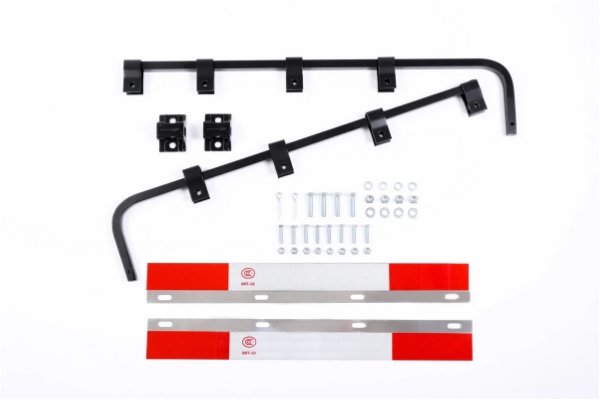
Aluminum Alloy Reflector Plates (XKJ-MFS-Q24AL): These plates offer a net weight of 0.5 kg and provide a rigid, flat surface for reflective strips, ensuring the tape remains visible and does not wrinkle.
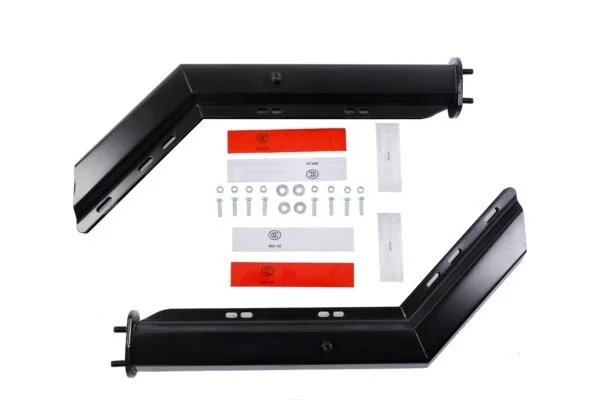
Enhanced Visibility: Our Mud Flap Hanger Set with Reflector Tape (XKJ-MFH-03-1/8) integrates the reflective element directly into the hanger hardware, ensuring that the rear visibility is maintained even if the mud flap itself is damaged.
Comparative Analysis of Reflective Solutions
| Solution Type | Durability | Installation | Best Use Case |
| Standard Adhesive Tape | Moderate (may peel) | Direct application | Trailer sides |
| Aluminum Reflector Plates | High (corrosion resistant) | Bolted to hardware | Rear mud flap areas 555 |
| Reflective Mud Flap Hangers | Maximum (structural) | Part of frame assembly | Heavy-duty semi-trucks 6666 |
Technical Deep Dive: Mud Flap Hanger Specifications
For the North American market, the strength of the hanger is as important as the visibility of the reflector. Heavy-duty vehicles require hangers that can withstand high-vibration environments.
Angled vs. Straight Bar Hangers
Angled Bar Truck Hangers (XKJ-MFH-Q3C): These sets come equipped with reflector plates and weigh approximately 8.25 kg (gross), providing the necessary weight and tension to keep reflective mud flaps in the correct position.
Straight Bar Bracket Kits (XKJ-MFH-SBK): A lighter option (5.88 kg gross) suitable for standard trailer configurations where horizontal alignment is prioritized.
Material Quality and Performance
The use of stamped steel bases and cast iron components in our production process ensures that hangers do not sag over time. A sagging hanger changes the angle of the mudflap reflector, potentially taking it out of the legal “retroreflective” range required by the DOT.
Installation and Maintenance Standards for 2026
Proper installation is the difference between a compliant fleet and a liability.
Surface Preparation
Before applying any reflective material or mounting a mudflap reflector plate, the substrate must be cleaned with a degreasing agent. Aluminum alloy surfaces, such as those found in our SKU XKJ-MFS-S24AL, are ideal for long-term adhesion.
Height and Angle Requirements
· Ground Clearance: Mud flaps and their hangers must be positioned to prevent spray while ensuring the reflective elements are within the sightline of standard passenger vehicle headlights.
· Angle of Incidence: Reflective plates, such as the Angled Mud Flap Support Bar (XKJ-MFH-S2C), are engineered to maintain a specific angle, ensuring that light is reflected back to the source (retroreflection) effectively.
Sourcing and Supply Chain Reliability
Why Factory-Direct Expertise Matters
Supply Chain Stability: A well-established supply chain system allows for consistent quality across bulk orders.
Advanced Production: Using efficient production equipment and skilled technical personnel, we produce truck fender accessories that meet the precision requirements of the North American market.
Quality Certification: Our operations are certified under the ISO9001 management system, ensuring that every international mud flap hanger meets global standards.
Conclusion: A Strategic Approach to Conspicuity
Compliance with DOT reflective tape requirements is not a static task; it requires ongoing attention to material quality and hardware integrity. By integrating mudflap reflectors with durable international mud flap hangers, fleet operators can ensure they meet FMVSS 108 standards while reducing long-term maintenance costs.
For B2B wholesalers, the reliability of a manufacturer is paramount. US TRUCK GOAT has been serving the trucking industry since 2000.
In 2026, the emphasis has moved from “just enough” quality to “100% reliability”. Selecting a parts supplier with 20 years of experience in the production of truck components ensures that the products you’re buying are built to withstand the toughest conditions. Whatever your requirements, whether aluminium alloy reflector plates or heavy-duty hanger sets, it makes sense to select high-quality products that are manufactured with precision for the protection and continued success of your business.

